
Who owns condos in Barrie, and what they’re selling for
Condos are a smaller part of Barrie’s housing than in most big Ontario cities. The 2021 Census counted 11.6% of Barrie’s occupied homes as condominiums. Only 7.7% of homes were in buildings of five storeys or more, and another 11.6% were in low-rise apartment buildings under five storeys.
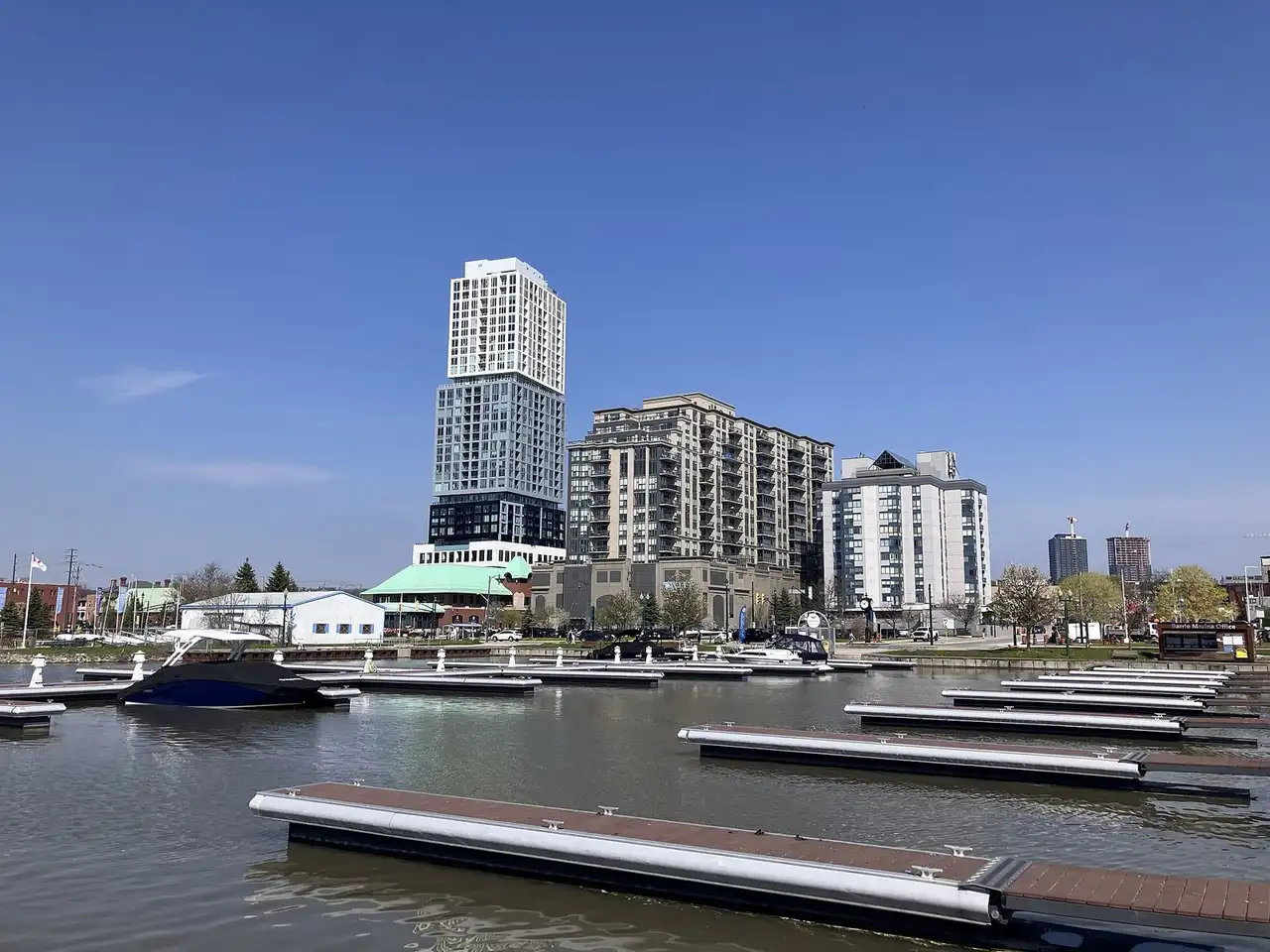
The taller buildings sit near the water, around the marina and the downtown shore of Kempenfelt Bay. Older low-rise buildings and condo townhouses are found in many other parts of the city.
Many owners pick a condo to live close to the bay and to transit. Allandale, the old railway neighbourhood on the bay’s southern shore, has had GO train service at the Allandale Waterfront station since January 2012.
Condo prices in Barrie are lower than a year ago. In September 2026, 19 condo apartments sold in Barrie at an average of $433,784 and a median of $393,500, according to TRREB, the board that now covers Barrie. The average was 24.1% lower than a year earlier.
Nineteen sales is a small number, so one or two large or small units can swing the average. The steadier figure is the benchmark price, which tracks a typical unit over time. Barrie’s apartment benchmark was $416,600 in September 2026, down 6.28% from a year earlier.
How much a Barrie condo could qualify for, by age
Two things set the most you can get: your unit’s appraised value and the youngest owner’s age. An appraisal is a visit from a certified appraiser, who sets the home’s value for the lender. The table uses Barrie’s September 2026 apartment benchmark of $416,600 as an example.
| Youngest owner’s age | Up to about (% of appraised value) | On a $416,600 condo |
|---|---|---|
| 60 | 48.55% | about $202,000 |
| 65 | 50.55% | about $211,000 |
| 70 | 52.85% | about $220,000 |
| 75 | 57.75% | about $241,000 |
| 78 and older | 60% | about $250,000 |
Each figure is a ceiling, not an offer. Lenders can lend less on some buildings or some units, and the appraisal of your own condo sets the real number. To try your own value and age, use the Barrie reverse mortgage calculator.
If you still have a mortgage on the condo, it gets paid off first, out of the reverse mortgage. The lawyer or title company pays off your current mortgage and the costs, then deposits the remaining money into your bank account.
What the lender looks at in your building
With a house, the lender mostly cares about the house and the lot. With a condo, the lender also cares about the building around your unit, because the building’s health affects what your unit is worth later.
The appraiser looks at your unit and at the building: its age, its condition and how units in it have been selling. A tower near the water and a 1980s low-rise can both qualify. They are simply judged on different things, such as recent sales in the same building.
Each lender sets its own condo rules. A building one lender is careful about can suit another, which is one reason to have every lender compared before you apply. Richard looks at your building early, so a lender’s condo rule doesn’t surprise you halfway through.
The status certificate: your condo corporation’s own summary
A status certificate is a document from your condo corporation that sums up its money and legal affairs. Under Ontario’s rules, anyone can request one, the corporation can charge up to $100 including taxes, and it must deliver it within 10 days, according to the Condominium Authority of Ontario.
It can tell you about the reserve fund (the building’s savings for big repairs), whether your unit’s fees are paid up, any special assessments, and any lawsuits. You may never need one for your reverse mortgage. Still, if your board has warned of big repairs, knowing what’s in it helps Richard plan the amount you take.
Your condo fees stay yours, just like property tax
A reverse mortgage removes required monthly mortgage payments. It doesn’t remove your other bills. Condo fees, property tax and insurance remain your bills, and staying current on them is one of the loan’s conditions.
Condo fees matter more than most owners realize. The Condominium Authority of Ontario explains that unpaid condo fees give the corporation an automatic lien on the unit, a legal claim it can register on title. In rare cases a corporation can even go to court to sell a unit to collect.
That’s why it can make sense to set part of the money aside for the building. Keeping a year or two of fees in the bank, or the amount of a known special assessment, makes each increase easier to handle.
Property tax works the same way for a condo as for a house. Barrie’s 2026 residential tax rate is 1.467503%. As an example, a condo assessed by MPAC at $250,000 would pay about $3,669 for 2026. Your own bill depends on your assessment. Barrie owners 65 and older should also read about the City’s tax deferral program in our guide to Barrie property tax for seniors.
What a reverse mortgage costs on a condo
The costs are the same on a condo as on a house. When we checked on October 2, 2026, lenders’ advertised 5-year fixed rates were between 6.23% and 6.94%. Since nothing has to be paid monthly, the interest joins the balance, compounding twice a year as Canadian mortgages do.
Expect roughly $2,000 to $3,500 in one-time costs, all together: your own lawyer, the closing legal work, the lender’s set-up fee and the appraisal. The appraisal is often paid up front, though some lenders front it and settle it at closing. The full breakdown is in our guide to reverse mortgage costs in Barrie.
Your home stays yours. When the loan comes due, what you owe can never be more than your condo’s fair market value, provided your property tax, insurance and upkeep stay current. It’s typically called the no negative equity guarantee. That protection still applies if Barrie condo prices fall.
Keeping the condo or selling it: a fair look
Some condo owners ask whether they should sell instead. In a month like September 2026, with the average condo apartment price down from a year earlier, selling means accepting today’s price plus the costs of moving.
A reverse mortgage lets you keep the condo, keep the view and keep your routine, while you use some of its value now. Selling can still be the right call, especially if the building no longer suits you. Our guide to downsizing in Barrie lays out what a move would cost you.
The money from a reverse mortgage is tax-free because it’s a loan, not income. It doesn’t affect your Old Age Security or Guaranteed Income Supplement.
What to have ready as a condo owner
When you’re ready to apply, the list is short. Each owner brings two pieces of ID, ideally a driver’s licence plus a passport. Add your mortgage statement, your property tax bill and a statement of your condo fees. You just tell Richard your income; proof is rarely needed.
If your board has announced a special assessment or a large fee increase, mention it when you ask for your estimate. It changes how much you might want to take, and it’s easier to plan for at the start.
Richard compares every reverse mortgage lender in Canada for your condo and your goals. Then he recommends the option with the best overall value, by email, so you can decide at home with no sales pressure.
How Richard helps you with this
- Checks your condo against every reverse mortgage lender in Canada
- Tells you early if a lender is likely to be cautious about your building
- Works out how much your unit could qualify for at your age
- Plans around a special assessment or a fee increase you know is coming
- Shows how much is left after your current mortgage and costs are paid
- Explains how condo fees, property tax and insurance fit the loan's rules
- Helps you find a lawyer near Barrie for your independent legal advice
- Stays your contact by email, phone or video through closing day
Barrie guides that go deeper
- What are home prices in Barrie right now?
- How much does a reverse mortgage cost in Barrie?
- How much does it cost to downsize in Barrie?
- What property tax help can seniors get in Barrie?
Sources
Figures checked October 16, 2026.
- TRREB, Simcoe County Market Watch, September 2026 (released October 6, 2026)
- Statistics Canada, Census Profile 2021, City of Barrie (CSD 3543042)
- Condominium Authority of Ontario, Status Certificates (checked October 16, 2026)
- Condominium Authority of Ontario, Liens (checked October 16, 2026)
- City of Barrie, By-law 2026-044, 2026 Tax Rates (passed April 29, 2026)
- Government of Canada, Construction completed on new Allandale Waterfront GO Station (January 29, 2012)
- City of Barrie, Historic Neighbourhood Guide (checked October 16, 2026)
- reversemortgagebroker.ca, Best reverse mortgage companies in Canada (rates checked October 2, 2026)